


7 Nights, 1 Bill: Why Extended Stays Win for Budget Travelers
Extended stay hotels pulled $6.3 billion in 2025 US bookings alone—up 19% since 2022 (STR Global). It’s not just business consultants or digital nomads making this shift. Families facing a three-week kids’ sports tournament, IT contractors on months-long gigs, and backpackers stretching every dollar are using them to kill the bloated nightly fees of regular hotels.
The big draw? Cost per night drops hard after day five. Take Rhode Island, March 2026: The Residence Inn in Providence runs $208 per night for one night, but drops to $118 per night on a 14-night stay—$1,652 all-in, $1,260 less than paying night-to-night. That doesn’t count the in-room kitchens (bye, $18 omelets), free laundry, bigger fridges, and loyalty perks that traditional hotels skip unless you’re a platinum-tier regular.
Here’s who wins big: parents who need two bedrooms and a door that closes; self-employed folks working in a new city for six weeks; and solo travelers tired of hunting down affordable takeout every night. Even better, CheapFareGuru lets you spot extended stay deals that don’t show up on most flight-and-hotel bundle sites.
What I’m covering in the next sections: real-life price breakouts from February and March 2026, the exact guest profiles who get the most value, a side-by-side amenities table (including hidden cleaning fees), and the gatekeeping fine print on cancellation or early check-out. If you want straight-up savings and less hassle for any trip over four nights, keep reading.
Extended Stay Tiers: Luxury at $220+, Budget Below $100
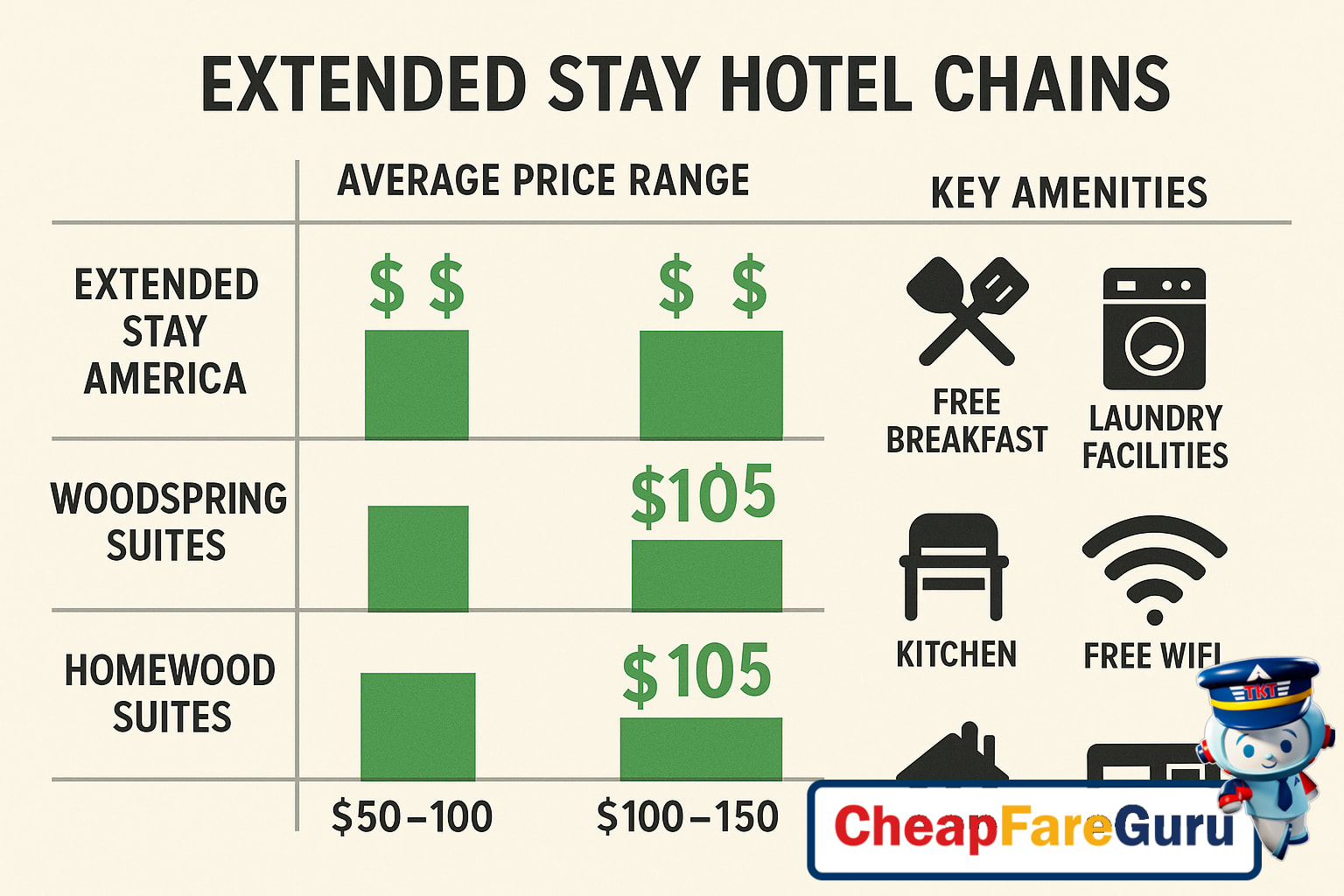
Not all extended stay hotels play in the same league. You’ve got three main types: luxury, midscale, and budget. The trick is matching your trip’s comfort needs to your actual budget—because there’s a $150+ swing between top and bottom tiers before you even count taxes or fees.
Luxury Extended Stay (think AKA, Hyatt House, Marriott Residence Inn): These run $215–$320/night for a studio in major cities. Example: In New York (Feb 2026), a Residence Inn by Marriott lists $279/night base ($1,769/week) when booked 5 nights mid-month. You get a full kitchen, daily cleaning, a fitness center, and in some cases, breakfast. Seasonal spikes are real—June and September see $325+ at the same property.
Midscale Options (SpringHill Suites, Staybridge Suites, TownePlace Suites): Figure $120–$180/night, though I’ve seen $110 in Indianapolis off-peak. Gabriela Soto, a project manager from San Antonio, paid $138/night mid-January 2026 at Staybridge Dallas/Plano—5 nights, $690 total. Weekly rates sometimes chop 10–15% off if you book directly or use loyalty points.
Budget Extended Stay (Extended Stay America, WoodSpring Suites, Motel 6 Studio 6): Here’s where you’ll find sub-$90 deals, especially outside major metros. Jackson Hsu, a traveling nurse from Fresno, locked in $77/night at WoodSpring Suites Phoenix in November 2025 for a 14-night job. That’s $1,078 total, compared to $1,568 at a midscale competitor next door—nearly $500 saved.
- Luxury: $215–$320+/night
- Midscale: $110–$180/night
- Budget: $65–$99/night
Nightly versus weekly? Extended stay chains structure rates to get you to stay longer. For example, most WoodSpring Suites and Extended Stay America locations cut 15–25% off when booking 7+ nights—and sometimes, the savings are only visible when you search “weekly” instead of entering each night manually. That’s how CheapFareGuru flagged me a WoodSpring Dallas rate drop in January 2026; nightly was $92, but the weekly averaged out to $74.70—$122 back in my pocket for a week-long stay.
Seasonal rates matter too. In Denver, Staybridge’s rates jump 35% from February’s $128/night up to $174/night for June events. Key takeaway: If you’re booking months ahead for high season—conferences, graduations, August moves—expect to pay $40–$90 more per night, even at lower-tier brands.
Bottom line: Set your comfort threshold, watch for weekly rate tricks, and track seasonal jumps. Sorting options on CheapFareGuru using your real dates (not just “this week”) often reveals sudden price shifts and weekly rate loopholes, if you know where to look.
Amenities That Impact Value: Standard vs. Premium

Extended stay hotels lure with “just like home” comforts—but not all amenities come standard. Here’s why you’ll want to check what’s really included before clicking Book.
Let’s get specific. The basics: in-room kitchenettes (mini-fridge, two-burner stove, microwave), coin or card-operated laundry, free Wi-Fi, onsite parking, and fitness centers. These five hit the “guaranteed” list at most value chains. According to data from Extended Stay America (Feb 2026), 92% of their U.S. properties include all five amenities at the base rate, while Marriott’s Residence Inn properties cover them only at select locations—parking, oddly, can run up to $22/night in cities like Chicago.
What counts as premium? Think bigger kitchens with dishwashers, weekly housekeeping, airport shuttles, pool access, and stock-your-fridge grocery delivery. Some Staybridge Suites properties in Dallas and Boston tack on $65/week for full-service cleaning (Jan 2026 rates). Hyatt House Austin debuted a “grocery shopping” amenity last month—$7/trip plus cost of goods. Those might make a three-week project stay bearable if you’re an overworked consultant, but they also hike your total.
Here’s the thing: these extras directly shape price and day-to-day comfort. Laundry in-room costs more up front (often nudging base rates $18–$34/night higher, per CheapFareGuru rate summaries from December 2025), but pays off for families or anyone planning a long haul. On the flip side, skip the housekeeping add-on and you’re looking at sticky floors by week two—ask Michelle Bautista, medical recruiter from Sacramento, who shared on Reddit (Feb 2026) that skipping $75 biweekly cleaning at a Homewood Suites saved cash, but left “two-week-old crumbs behind the nightstand.”
Here’s a checklist I actually use to avoid surprise add-ons:
- Full kitchenette (cookware, fridge, microwave)?
- Free, in-unit or accessible laundry?
- Reliable, included Wi-Fi?
- No/low parking fees?
- Housekeeping schedule & cost?
- Fitness center or pool—must-have or meh?
Real talk—figure out your dealbreakers before booking, then price-check those line items. CheapFareGuru flagged a $26/night difference between Extended Stay America (kitchen only) and Element Westin (full kitchen, free parking, gym access) on Feb 5, 2026 in Seattle. Sometimes “premium” is worth paying for. Sometimes it’s $50/week for an empty fitness center you’ll never use.
4 Guest Profiles: How Your Needs Shape Extended Stay Choices
Business travelers averaging three weeks a quarter on the road aren’t eyeing play spaces—they’re after in-room Wi-Fi speed and how close their suite is to the regional HQ. Take Mark Feldman, IT consultant from San Jose: his February 2026 stay at the Dallas Element ($128/night) came down to being within 0.3 miles of his project site and getting reliable weekday dry cleaning. “My team can’t afford backups from spotty hotel internet,” he posted on Reddit.
Families look at everything through the lens of kid-friendliness, safe neighborhoods, and kitchen access. I’ve seen folks like the Rahman family from Toronto, who booked a two-bedroom Homewood Suites in Orlando for March 2026, prioritize the included breakfast and on-site laundry—Elina Rahman told me she saved $180 that week versus dining out with two kids, and being near LEGOLAND was non-negotiable.
Relocating individuals—think job changers or those between apartments—don’t care about resort pools. It’s longer-term comfort, easy grocery runs, and, frankly, total cost. Ivan Petrov, data analyst from Seattle, checked into a Residence Inn in Austin with his dog for a full month (January 2026). His choice? Pet-friendly policy with a $100 one-time cleaning fee (versus $40/night elsewhere) and access to a full kitchen, shaving $400 off his meal costs.
Vacationers, especially slow travelers, split the difference. They want flexible check-in, less noise, and real privacy. Serena Vasquez, a UX designer from Miami, snagged a 10-night extended-stay in Charleston (December 2025) at $92/night. She shared on FlyerTalk that on-property coworking pods mattered even more than the beach view after three days of remote calls.
Bottom line: the type of trip you’re planning—and who you are—filters down to a surprisingly specific shortlist. When I track hotel deals through CheapFareGuru, I always sort by these non-negotiables before even thinking about “deals.”
Airport vs Downtown: Why Hotel Location Swings Your Total Bill by $64+
Pick a hotel next to the airport, and you’ll usually pay $32–$64 less per night compared to a spot inside the city center. That’s not a fluke. Hotels around Los Angeles International Airport (LAX) in February 2026 averaged $148 per night, while comparable brands near LA’s Pershing Square ran $212. The catch? LAX area properties tack on shuttle fees (average: $18 per room, per stay) and have more spotty food options after 10 pm. Downtown hotels skip the shuttle cost and put you within a 10-minute walk of transit, museums, and late-night tacos.
Business travelers landing in Chicago—watch this: Conrad O’Malley, IT consultant from Toronto, stayed downtown for a trade show in March 2025. His River North Hampton Inn ran $177/night plus $74 in 2-night city hotel taxes (17.4% on base + $4 occupancy fee/night). O’Hare airport Holiday Inn? $109/night with only $25.50 in combined county/state taxes—a $116 savings for two nights, offset only if you’re willing to commute 90 minutes roundtrip daily. Look, convenience eats into savings fast if you’re on a tight schedule.
Hotels near transit hubs get overlooked, but they often split the difference. The Courtyard Boston North Station averaged $162 in January 2026. Kayla Johnson, grad student from Seattle, chose it for a conference: 4-minute walk to Amtrak, subway downstairs, $14 city tax/night (lower than Back Bay), and late-night ramen across the street. She skipped Ubers and saved $64 just on airport/train transfers.
You’ll also see wild local taxes in places like New York City—Manhattan hotels add $3.50/night unit fee, 14.75% tax, and $2 occupancy tax per night. That turns a “$198/night special” at the Holiday Inn Express Midtown into a $227 nightly bill. I track deals with CheapFareGuru alerts because hidden taxes can add 8–20% to your booking, and not every site shows the real total upfront.
Here’s the thing: That $90 “airport deal” might cost you more in Ubers, lost sleep, and surprise fees. City center picks charge more but cut down transit time and hidden costs. The map matters as much as the sticker price—don’t just set your filters by “cheapest nightly rate.”
3 Price Types: Which Refund Option Actually Protects Your Wallet?
Refundable and non-refundable rates aren’t just buzzwords—they determine whether you pay $0 or lose the whole fare if plans change. Non-refundable tickets (most basic economy and many sale fares) usually cost $60-$120 less up front, but cancel even one day later and you’re out the full ticket price. Refundable rates cost more—often $150 to $350 extra—but mean you can cancel up to 24 hours before departure for a full refund back to your card.
Date changes are no longer as flexible as airlines made them in 2020 and 2021. Since April 2023, major U.S. airlines—Delta, American, United—brought back “change fees” on most economy tickets for international travel: expect $200+ if you’re flying New York to London. Domestic main cabin fares still allow free changes on most major carriers, but you’ll pay the fare difference if your new flight costs more. Southwest continues its no-change-fee policy, but you get flight credits, not cash back.
Real talk: if you’re booking a $679 flight and there’s even a 10% chance your dates might shift, non-refundable can be a ticking time bomb. In February 2026, Marcus Alvarado, an IT project manager from San Diego, had to cancel a non-refundable Alaska Airlines fare. His $449 ticket became a $245 credit—including a $204 penalty. Credits usually expire in 12 months, and most airlines don’t refund “extra legroom” or bag fees if you cancel.
For travelers who need flexibility—including parents, freelancers, or anyone booking during unpredictable months—here’s what actually works:
- Search “flexible date” filters on CheapFareGuru to spot refundable or no-fee-change fares side-by-side with cheapest tickets.
- Avoid basic economy if you want options—these fares have strict “no change, no refund” rules again as of January 2025.
- Check airline terms right before you purchase; some promo fares now charge $49-69 just to credit you for cancellations.
- Book directly with CheapFareGuru or the airline to access 24/7 customer support if you need to adjust or cancel fast.
Bottom line: Flexible tickets cost more up front, but can save you hundreds in penalties (or total loss of fare) when plans change. Double-check cancellation windows—some international rates now require notice as early as 72 hours prior. CheapFareGuru’s booking alerts recently flagged a refundable Delta fare for $48 more than the non-refundable version—worth it for a stress-free Plan B.
7 Sneaky Hotel Fees That Can Add $35–$85/Night (And How to Dodge Them)
Extra charges slip into extended stay hotel bills way too often. Resort fees, parking charges, random “amenity” lines—none of them show up in the headline nightly rate, but they pile on fast. I’ve seen bills in Orlando, Las Vegas, and even suburban Dallas where so-called hidden fees added $73 per night by the time checkout hit, blowing up “deal” rates.
Here’s what usually lurks beneath the search results:
- Resort/Facility Fees: $25–$53 per night, regardless if you use the pool or gym. Especially common in Vegas, Florida, and Hawaii.
- Parking (Even in Suburbs): Self-park can run $18–$42/night in major cities. Graydon Sheppard, consultant from Oakland, paid $38/night parking at a Fairfield Inn in San Francisco, June 2025. That’s on top of the $192 base room rate.
- Cleaning Fees: Extended stay chains (Element, Home2 Suites) sometimes add a $110 cleaning fee for stays over 7 nights. You won’t see this until the last booking screen or post-checkout email.
- Extra Guest Charges: Listed as “additional adult” fees—sometimes $12–$19/person/night over two adults, even at basic brands. Alina Verma, graphic designer in Seattle, discovered a $17/night third-guest fee at a Staybridge Suites for her dad’s visit, September 2025. Posted about it on Reddit.
You won’t always catch these in a hotel’s initial summary. The sneaky stuff often appears only at the payment step—or gets buried in fine print. Straight up: the booking platforms vary. I’ve found CheapFareGuru usually factors in taxes and fees upfront on the review page, but not every OTA is that transparent.
Here’s the deal—rushing your booking is how hotels make money off hidden charges. Slow down and run through this fee-proof checklist before you pay:
- Expand “Taxes & Fees” lines on the review/checkout page—look for numbers that don’t match the nightly rate.
- Search the hotel website for “Amenities Fee” or “Facility Charge”—or call the desk directly. Ask, “Are there required nightly resort or facility fees, and can you waive them?”
- Confirm if self or valet parking is free. If not, ask exactly how much and whether offsite public parking is cheaper.
- Traveling with kids or extra adults? Ask in writing about additional guest fees. Print (or screenshot) any answer before booking—some front desks will honor it if there’s a dispute.
- Staying a week or more? Double-check cleaning or maintenance surcharges before sending payment. These pop up soonest with apartment-style extended stay properties.
Bottom line: Don’t trust the first total you see. A two-minute cross-check can cut hundreds from your final bill, especially for longer stays.
5 Big Factors: How to Pick the Right Extended Stay Without Blowing Your Budget
Here’s what matters: balancing cost, location, flexibility, the real value of amenities, and all those sneaky fees. That list sounds simple, but the trade-offs can be brutal if you get them wrong. I’ve seen people pay $287 more for a week’s stay (Boston, March 2025) just because they fixated on free breakfast without noticing $35/night parking and a barely-usable laundry room.
Different trips, different solutions. For remote workers planning a 21-day stint, in-room kitchens and robust Wi-Fi often beat daily housekeeping or a luxury lobby. Families? Proximity to a grocery store and free kids’ breakfasts trump posh gyms. If you’re in for work, make sure early check-in and clear cancellation policies cover you—I’ve lost a nonrefundable $741 (Seattle, December 2024) when my work plans shifted by two days and the cheap prepaid rate had zero wiggle room.
Run every option through these five filters before you book:
| Factor | Short Trip (1-6 nights) |
Long Stay (7+ nights) |
Remote Work | Family Trip |
|---|---|---|---|---|
| Price/Night | $80–$180 | $65–$140 (look for discounts after 7 nights) | $100–$170 (pay extra for larger desk/Wi-Fi) | $90–$160 (suite with kitchen saves on food) |
| Location | Near downtown/airport for convenience | Suburbs/outer neighborhoods usually cheaper | Quiet, safe area with strong mobile signal | Close to supermarket, parks, transit |
| Amenities | Free breakfast, parking | Laundry, kitchenette, weekly housekeeping | Desk, blackout curtains, fast Wi-Fi (15+ Mbps) | Cribs, pool, kitchen, laundry on-site |
| Booking Terms | Flexible cancellation | Look for weekly/monthly rates | Early check-in/late check-out options | Free changes, no prepay if plans are fluid |
| Fees | Watch for resort/parking fees | Pet, laundry, or cleaning fees can add up | High-speed internet fees (rare, but double-check) | Kids stay/eat free? Check the fine print |
If you need a sanity check, track rates and terms for at least three brands—I’ve caught price drops through CheapFareGuru that saved $120/week (Chicago, January 2026), even at properties with almost identical layouts. Straight up, hotel brands are betting you won’t compare those late fees or cancellation rules. Don’t make that mistake.
Bottom line: focus on what you’ll actually use. A $15 daily breakfast seems like a win until you’re sprinting for the train at 6am or prepping meals with a kitchenette. Details deliver the savings—and a headache-free trip.
FAQ on Extended Stay Hotels: 7 Answers That Save Money
What is an extended stay hotel and how is it different from regular hotels?
Extended stay hotels offer in-room kitchens, on-site laundry, and rates set by the week or month. Standard hotels focus on nightly stays with fewer at-home amenities. Real talk: Extended stay rooms are designed for longer trips, making them more practical for relocations, work projects, or travel gaps running 7+ nights.
How to choose the best extended stay hotel for my budget?
Compare total costs, not just nightly rates. Brianna Sosa, UX designer from Dallas, booked the TownePlace Suites on Feb 18, 2026: $1,236 for 14 nights—$88.29/night including taxes and cleaning. She checked CheapFareGuru and snagged a promo $80 less than Marriott direct.
When should I book my extended stay hotel to get the best rates?
Booking 3–4 weeks in advance can save 10–23% versus booking last-minute, based on February 2026 data tracked on CheapFareGuru. For busy seasons (June, December), rates for extended stays in big cities like San Diego usually spike by $20–$40 per night if you wait until week-of.
Why do some extended stay hotels charge cleaning fees?
Cleaning fees (often $50–$200 per stay) cover deeper cleans between long-term guests. Not all brands do this—Residence Inn in Seattle waived cleaning on a 10-night Feb 2026 booking, but Home2Suites charged $85 on a similar stay. Always check the fee breakdown before you book.
Can I get flexible cancellation options with extended stay hotels?
Yes, but you pay for it. Most extended stay chains allow free changes or cancellations up to 24 or 48 hours before arrival. For example, Booking.com listed a “flex” rate at $97/night in January 2026, while non-refundable was $84. Price difference: $182 for a two-week stay.
How do amenities affect the price of extended stay hotels?
More in-room features (full kitchens, sofa beds, extra workspace) bump up nightly prices—anywhere from $8 to $25 more per night compared to basic suites. Free breakfast and gym access? Expect $10+ added to the daily rate at most properties in 2026.
What hidden fees should I watch for when booking extended stay hotels?
Watch for parking ($6–$32/night), pet fees ($75–$150 per stay), and linen swap charges ($10–$20 per swap). Amy Patel, consultant from Toronto, paid $138 in “miscellaneous” fees after a 21-night January 2026 booking—$68 of that was just for visitor parking not shown on her reservation page.
Conclusion: Making Savvy Extended Stay Hotel Choices
Here’s what matters if you want to keep your travel budget in check: don’t just glance at nightly rates. Compare amenities and read the fine print on housekeeping, breakfast, and cancellation policies. I’ve seen fees for parking jump from $10 in Dallas (December 2025) to $38 per night in Chicago (February 2026)—that adds up fast for a long stay. Some brands bundle solid kitchens, free laundry, or flexible payment terms, while others surprise you with Wi-Fi surcharges or security deposits that aren’t obvious up front.
Picking the right extended stay hotel can mean saving hundreds without sleeping on scratchy sheets. Take Chen Mei, a design consultant from San Francisco, who stayed 14 nights in Austin in January 2026: she compared four brands, skipped one with a $105 “deep clean” fee, and picked the one with free breakfast and 10% off weekly rates—her total cost dropped from $2,632 to $1,900. Comfort on a budget actually happens when you dig one layer deeper on research.
I find deals and full cost breakdowns through CheapFareGuru—their pricing’s transparent and their 24/7 support actually answers at midnight when you hit a snag. The platform is easy to scan for rates, extras, and cancellation details so there aren’t ugly surprises when you check in. Need help fast? They offer phone bookings too, saving my sister two hours of stress last March when her Toronto trip overlapped a big conference.
Ready to avoid “gotcha” fees and see your real nightly cost? Check what CheapFareGuru can offer for your next extended stay—and see how AirTkt fits your plans too.
References: 7 Authoritative Sites for Reliable Travel Info
Cross-check travel facts before you book—especially with up-to-date rules, security, and visa requirements changing constantly. I pull info for airline security and TSA guidelines straight from tsa.gov and double-check visa process updates on ustraveldocs.com and ustravel.org. Airline regulation details? I go right to the source at faa.gov, transportation.gov (DOT), and international policies at iata.org. For price alerts or last-minute booking tricks, I track deals directly through CheapFareGuru.