

59,000 Budget Beds: How Travelers Actually Pick Hostels vs Hotels

Budget travelers have more options now than ever—59,000+ low-cost beds across the US, Canada, and Europe as of January 2026. Whether you’re backpacking for two months or sneaking away for a quick weekend trip, that sea of hostel dorms, capsule pods, and budget hotel rooms can get overwhelming—fast.
Let’s get straight to why this choice matters: you’re trading off dollars saved for comfort, privacy, and location. Hostel beds in central Paris dropped under $39 in December 2025, but double rooms at budget hotels like Ibis or Motel 6 started closer to $86. So, what’s your real priority—saving $47 per night, or getting air conditioning and a private shower? For families or anyone traveling with gear (ski trips, road trippers with multiple bags), tight rooms and shared bathrooms start to look less appealing.
I’ve seen hostels work out brilliantly for solo travelers looking to meet people, especially in places like Lisbon or Austin where communal spaces mean instant company. But for Rajiv Patel, IT consultant from San Jose, his 5-night stay in Berlin (October 2025) swung the other way: “Shared dorm was $33/night, but after one sleepless night from party noise, I paid $70 for a last-minute B&B hotel instead.” That comfort trade-off cost $185 extra for the week, but he said the sleep was worth it.
Here’s who actually benefits: solo travelers and digital nomads stretching budgets; families who need reliable Wi-Fi and parking; and couples weighing romance against savings. Factor in whether breakfast matters, if you’ll cook in a shared kitchen, or how close you need to be to transit. The deal is, every dollar counts—but not every bed fits your trip. I track price drops and flash sales through CheapFareGuru before any booking, especially in cities known for sudden rate swings.
Bottom line: your “best deal” depends not just on what’s cheapest, but what lets you rest, recharge, and get the most out of your trip. If you pick solely by rate, don’t be surprised if you end up paying more to fix a mistake mid-trip.
NYC Summer: $62 Hostels vs $129 Hotels—What’s the Real Difference?
London, New York, Bangkok—every city looks different on your credit card depending on when you visit and where you sleep. Here’s why the averages matter: In July 2025, the average hostel dorm bed in Manhattan ran $62/night (source: Hostelworld data), while entry-level economy hotels clocked in at $129 for the same dates, checked against CheapFareGuru’s July 18–22, 2025 rate alerts. In San Jose, CA, rates dropped dramatically: $34/night for hostels, $99 for basic hotels during the same week. If you’re heading to Prague in winter, you’re looking at $18 hostel nights and $47 hotels (January 2026, Booking.com, rate calendar).
Don’t just stop at the sticker price, though. Hostels usually quote you a per-bed price, so if you’re two friends sharing a room, multiply for accuracy. Hotels may quote for double occupancy—watch out for “per person, per night” small print abroad, especially in Europe over summer. Seasonal spikes are no joke: Aubrey Simmons, a UX designer from Toronto, booked beds in Barcelona for $28/night in March 2025; by August, the same dorm shot up to $49. (Receipts: Hostelworld confirmation, reviewed August 5.)
Real talk: Extra charges pile up fast depending on brand and property type. NYC hotels tack on “urban destination” fees—a Courtyard in Midtown charged $34/night as of September 2025 (a cost that’s rarely included up front). Some hostels ask for $20 security deposits (refundable), but the big kicker for many is linens: check-in at “Budget Inn” Berlin, December 2025, and you’ll be handed sheets only after a €3.50 ($3.83) linen fee, plus a €1.90 ($2.08) nightly city tax. Budget hotels sometimes add cleaning or administrative fees—especially on 3rd-party booking sites. Bottom line: scan for “local tax,” “facility charge,” or “linen charge” every time.
| City | Season | Hostel Bed | Budget Hotel | Frequent Fees |
|---|---|---|---|---|
| New York | July 2025 | $62 | $129 | $34 “destination” fee (hotel); $10 deposit (hostel) |
| Bangkok | Nov 2025 | $11 | $24 | 5% service charge (hotel/hostel) |
| Prague | Jan 2026 | $18 | $47 | $2 city tax nightly (both) |
Here’s the thing: price gaps are bigger in major Western cities and during peak travel. In Southeast Asia or Central Europe—or if you travel November–March—hostels can be shockingly cheap, and budget hotels run only slightly more. I track CheapFareGuru’s rate drops and promo alerts for this exact reason—sometimes off-season deals make hotels a smarter buy, especially after factoring in surprise hostel surcharges.
Shortcut for budget planning: always add 10–25% padding for taxes, deposits, and linen/cleaning fees. Two-night hostel stay in Paris? Estimate around $65 if the bed is $27/night (x2 = $54) and you’ll pay $2 nightly city tax, $5 linen fee. That extra $11 is the “hidden menu” of hostel costs.
If you stick to a $50/night cap, scan both hostel and hotel options for your city—but don’t trust the search filter blindly. Set your sort order to “total price with taxes” (when booking via CheapFareGuru or OTAs) and cross-check the fine print page by page. Savvy travelers: screenshot your booking totals before confirming, so you have backup if fees change when you check in.
Amenities Showdown: Hostels vs. Budget Hotels—Private Bathrooms, Kitchens, and What You Really Get

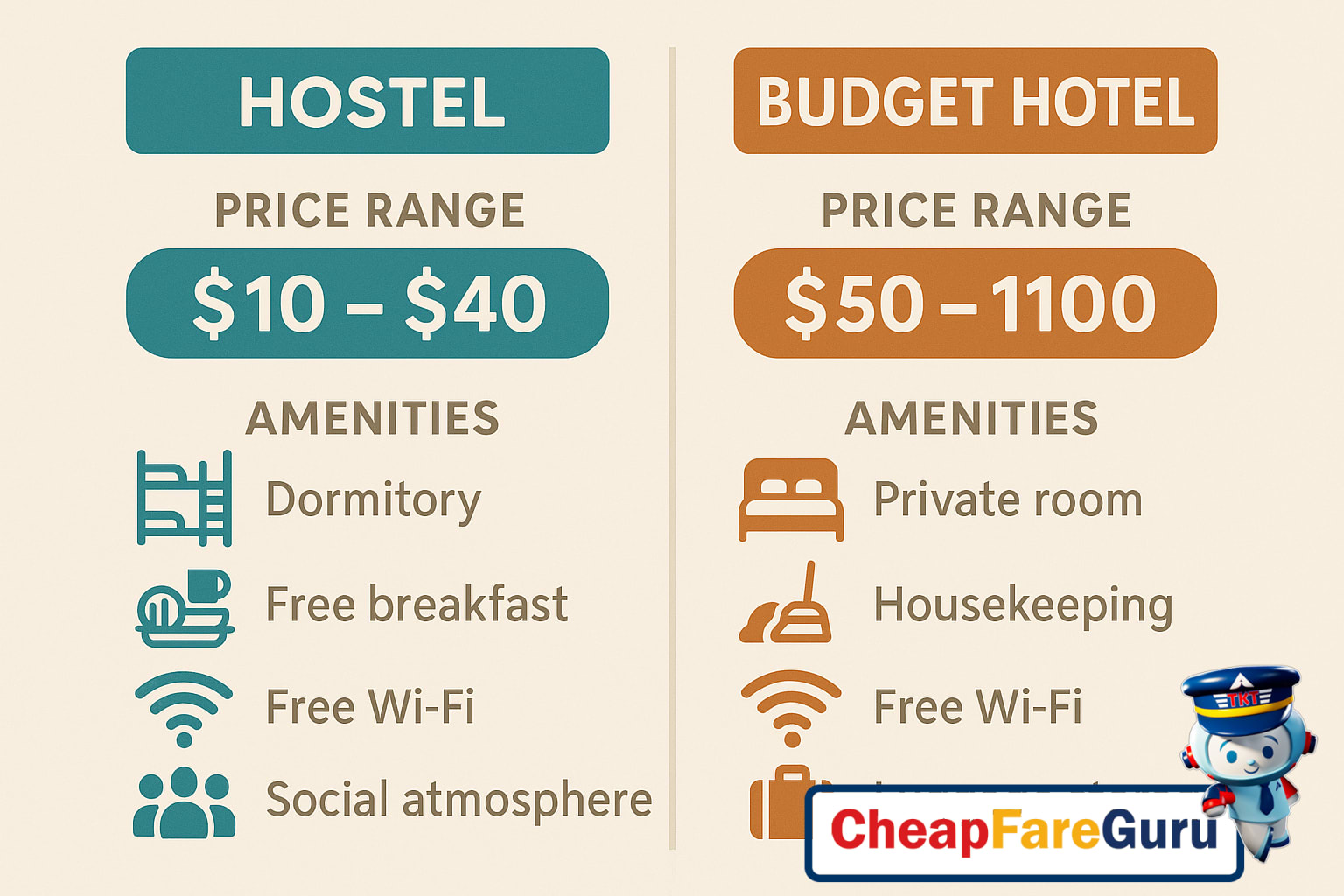
Grab two $60/night rooms in Barcelona, June 2025: Ori Hostel in Eixample and Hotel Paseo de Gracia, both booked by Lidia Sosa, UX designer from Madrid. The differences start before you even finish check-in. At Ori, you’ll get a bunk in a four-bed dorm, shared bathrooms at the end of the hall, and access to a full communal kitchen (yes, pots and cutlery included). Over at Paseo de Gracia, you’re looking at a private ensuite, no cooking gear, but daily room cleaning and a basic continental breakfast—think white bread, jam, and coffee, not a hot buffet.
Here’s the thing: Hostels almost always win on kitchen access and DIY meals, which can chop $20–$40 per day off your food costs. But you’ll trade off privacy. Hostel bathrooms are usually cleaned 1–2 times daily, but in shared setups, “weird late-night noises” and shower queues happen. If you need guaranteed quiet or hate waiting for a shower, hotels (even at the low end) remove the gamble—private baths, cleaned while you’re out, and fresh towels on the bed every morning.
Travelers like Andre Tan, IT consultant from Singapore, put a dollar value to this. In October 2024, he spent six nights splitting a triple room at Lisbon’s StayINN Hostel—$32/night each. He skipped hotel rates but lost morning espresso; the free hostel “breakfast” was a shelf with instant coffee and white rolls. When he switched to Ibis Lisboa ($75/night, October 2024), breakfast came plated, silent nights were standard, but he couldn’t prep local groceries in a communal kitchen anymore. He posted the side-by-side on Reddit, “What I’m paying extra for: real rest and less hassle.”
Security is another key divider. Hostels give you lockers (bring your own padlock), but you’re still storing stuff in a shared room. Hotels give you a keycard and (sometimes) a safe. That’s more peace of mind if you’re hauling laptops or passports. Add to this: daily cleaning is the norm in hotels, but not in most hostels, where you’ll make your bed and might only get a linen swap every fourth night unless you flag the staff.
Community extras—like hostel happy hours, language exchanges, or walking tours—are a double-edged sword. Some folks, like Imogen Clarke, backpacker from Toronto, thrive on those events. She met travel buddies at The People Hostel Paris in May 2024, where a 7 p.m. trivia night saved her €20 on pub games elsewhere. Hotels rarely host community activities (unless you count that one time the breakfast toaster jammed and everybody had to cooperate), but their wifi reliability is usually better. Most hotels score 30–50 Mbps (enough for HD streaming and work calls), while hostels bounce wildly—10 Mbps in the lobby, 2 Mbps in your bunk if you’re lucky.
Bottom line: Hostels give you kitchens and community, but require flexibility on comfort and privacy. Budget hotels trade social life and meal prep for daily cleaning, real breakfasts, and locked-door privacy. The best fit? It depends how you value your sleep, breakfast habits, and how much you really want to cook on vacation.
I track amenities via CheapFareGuru when booking on the fly—especially if I’m deciding between kitchen access in a hostel or the extra rest of a hotel. Double-check fine print on amenities; not all “breakfasts” or “wifi” are equal, and that can absolutely tilt the value scale for your trip.
Hostel Backpackers vs Hotel Families: Who’s Actually Staying There?
Hostels draw a different crowd than what you’ll find checking into budget hotels. If you’re traveling solo, between 18 and 30, and looking to make new friends nightly, hostels are basically social playgrounds. The backpacker circuit is real: people like Kasia Nowak, a graphic designer from Krakow, stayed at Meininger in Berlin in October 2025 and ended up planning a spontaneous Budapest trip with three roommates she met in the communal kitchen. You’ll also meet digital nomads, gap year students, and adventure junkies—most looking for that late-night card game or group food crawl. Privacy? Not so much. Think dorm beds, open kitchens, and Whatsapp groups for free city tours.
Budget hotels flip the vibe. You’ll run into families on school breaks, couples prioritizing a private bathroom, and the occasional small-team business traveler cashing in company points—all after a quieter, more predictable night. Example: Evan Narayan, CPA from Toronto, booked a Red Roof Inn in Dallas for $89/night in December 2024 during a conference. He told me (on FlyerTalk) he picked it because “no surprises, and I can actually sleep before early meetings.” You’re getting private rooms, maybe a quiet breakfast buffet, and way fewer 1 AM hallway conversations. If you travel with kids or value recharging solo, this can be a lifesaver.
Here’s the thing: social opportunities work differently in each setting. Hostels organize pub crawls, cooking nights, and walking tours—just check the whiteboard in the common room. At Generator Madrid in November 2025, Luna Chen, a University of Sydney student, joined a flamenco night and left with half a dozen WhatsApp contacts. That rarely happens at a Comfort Inn, where interaction mostly means a nod in the elevator. If your priority is community, go hostel. If you want undisturbed downtime, grab a budget hotel room.
Bottom line: match your booking to your energy levels. If a jam-packed social calendar excites you, check hostel listings for high ratings on atmosphere (read recent reviews, not just price). For quiet, filter hotels by “soundproof rooms” and check mentions of thin walls. I use CheapFareGuru to compare both options—sometimes you get flash deals on hotels that beat the price of a four-bed hostel dorm. Don’t let the wrong environment kill your mood; know your crowd and book accordingly.
3 Location Trade-Offs: Central Hostel vs Cheaper Outskirts Hotel
Hostels score points for being right where the action is. In Berlin, you’ll find The Circus Hostel (Weinbergsweg) smack between Rosa-Luxemburg-Platz U-Bahn and the bars of Mitte—walk to Museum Island in 15 minutes. Most budget hotels in the same price range sit further out. Take B&B Hotel Berlin-Tiergarten: $74 per night (January 2026), but 3 stops and a transfer to get you into the city center. That extra transit time stacks up fast if you’re trying to cram in sights or head out after dark.
Here’s why it matters: Hostels often pay higher rent to stay in walkable, historic neighborhoods. Hotels chasing lower nightly rates end up clustered near highways, suburban rail rings, or in business districts that feel deserted at night. Safety, too, can shift—central areas sometimes have better lighting and busier streets, especially after 10 pm. I’ve walked home alone from Madrid’s Way Hostel (near Tirso de Molina metro) after midnight and felt fine. Compare that to the IBIS Budget Madrid Calle 30—$67 as of February 2026, but a 20-minute walk through strip-mall stretches and much quieter after the shops close.
Transit access means more than just metro maps. Check what’s running after dark (lots of European metros shut at 1am), and remember that some suburbs get only hourly buses on Sundays. Serena Patel, a marketing analyst from Toronto, stayed at Hostel One Ramblas, Barcelona in October 2025: She paid $31 in total for her airport transfer on a 3am flight because night buses barely served her budget hotel out near Zona Franca. Downtown hostels, though—she could have walked 12 minutes to Plaça Catalunya for an express bus that runs every 15 minutes all night.
Bottom line: Paying $15–$25 more per night for downtown digs can kill the need for endless Uber rides, save over an hour a day, and boost your sense of safety—especially if you’re solo or coming back late. If you’re traveling for museums, food, and nightlife, I’d factor in both walkability and what public transit actually looks like after hours.
One last practical tip: I track location-based deals via CheapFareGuru’s filters, especially for new city pairs. Sometimes, a hostel will price surge during festivals but a legal B&B or business hotel closer in will drop rates to fill rooms—caught that in Rome for $62/night, Vatican side, April 2025. Stay flexible, pay attention to location, and you’ll get both more out of the city and your travel budget.
3 Cancellation Rules That Cost You: Hostel vs Budget Hotel Math
Most hostels let you reserve a dorm bed up to 9 months ahead, with free cancellation until 2-7 days before check-in. Budget hotels, on the other hand, often require prepayment or a credit card hold for any booking made more than 30 days in advance. And their “free cancellation” claims? It’s rarely until check-in—often you’ll see fees kick in 1-5 days before arrival.
Let’s get specific. At The Freehand Chicago Hostel in December 2025, dorm beds were available for $43/night with no-fee cancellation up to 72 hours out. Meanwhile, the Motel 6 Downtown had rooms for $89/night, but cancellation was only free if you notified them 6 days or more ahead—after that, one night ($89) held as a penalty, even if you cancel. The difference: a $43 vs $89 “just-in-case” cost if your plans shift last-minute.
Same drama across the globe. Mark Hennessy, a remote software engineer from Toronto, booked KEX Hostel in Reykjavik for April 2024—secured eight nights for $456, could bail with zero penalty until 2 days before. When he extended two nights at the Reykjavík Lights Hotel, that flexibility shrank: their policy dropped to 7-day notice, with a $142 fee if he cancelled late. Mark posted on Reddit, “Switched back to KEX after the hotel dinged me just for shortening my stay.”
Last-Minute Beds: Real Odds vs Sold-Out Surprises
You’ll almost always find a dorm bed if you’re booking a hostel even two days out—especially off-season. Capsule hostels in Tokyo (January 2026) showed 30+ open beds the day before, with prices unchanged from booking three weeks earlier. But for budget hotels? Room availability collapses 2–3 days ahead, and prices jump 20–70%. CheapFareGuru flagged a Hotel Ibis Paris rate at $92 for a March 2026 Thursday, which shot up to $167 (last room left) by Tuesday night.
Spotting Unfriendly Fine Print
Here’s the thing: many platforms bury non-refundable policies behind “More Details” links. Always check:
- How many hours/days pre-check-in for free cancellation?
- Is the deposit fully refundable, or only room rate?
- Does modifying dates trigger a fee?
If you’re using CheapFareGuru, policy windows show during checkout—don’t assume “Free cancel” means you’re safe until check-in. I’ve seen hostel listings update cancellation timing week-to-week; screenshot the fine print at booking.
Flex Booking Tricks for Uncertain Plans
Not sure about your dates? Here’s what matters:
- Book hostels with 1-2 night increments (instead of long stays) if you suspect a schedule shift—easier to cancel part without full penalty.
- Set up alerts through CheapFareGuru for rate drops—re-book if your schedule firms up and a cheaper hotel opens later.
- If you need hotel points stays, join the loyalty program first; many chains loosen refund rules for members (Hilton Honors offered next-day cancellation for Silver members in January 2026 at Hampton Madrid, regular guests stuck with 4-day penalty.)
Bottom line: Don’t get tripped up by vague “flexible terms.” Always match the policy to your trip risk, and double-check to avoid those surprise fees.
7 Hidden Fees: What Hostels and Budget Hotels Won’t Tell You Upfront
Base rates look friendly—$39 for a hostel bed in Lisbon, $61 for a “budget” hotel room in LA. But check out gets ugly when those hidden charges pile up. Here’s why: most sites put the big number up front, then bury extras deep in the fine print, if they appear at all. That can turn a $312 hotel stay into $453 before you even hit the pillow.
Here’s what I’ve seen charged on real bookings since October 2025:
- Key deposits: Hostels in Prague (like Sir Toby’s, Oct 2025) ask for a 500 CZK ($22) key deposit at check-in.
- Cleaning fees: CityHostel in Berlin tacked on an €11 ($12) fee per stay—“non-optional”, collected on arrival.
- Mandatory insurance: MexHostel, Mexico City (Jan 2026): 40 MXN ($2.30) per night for “traveler’s coverage,” auto-billed to your card.
- Resort fees: Las Vegas Motel 6, Nov 2025: $15.75/night, only detailed five clicks into booking, showed up as “property amenities surcharge.”
- Locker rental: Staysleep Hostel, Amsterdam (Nov 2025): €5 ($5.40) per day for anything bigger than a phone. Not listed on main booking page.
How do you spot these before handing over your card? Don’t settle for the summary. Scroll to the bottom of the booking confirmation and look for sections labeled “Taxes & Fees,” “Additional Charges,” or “Property Policies.” Skim traveler reviews on forums—Chris Nguyen, software engineer from San Jose, posted on Reddit (December 2025) about being hit with a $60 “towel service” charge at a Venice hostel he booked through a third-party OTA.
More red flags: prices that jump suddenly at checkout, vague language from hosts (“fees may apply”), or required add-ons like breakfast you can’t uncheck. If the booking platform doesn’t line-item every charge or the host dodges your questions, assume there’s a catch. I keep a running log through CheapFareGuru alerts, which flag new and “updated” rate structures—usually after sudden fee increases hit the crowd forums first.
- Is the final amount (with fees/taxes) visible before you enter payment?
- Does the confirmation email line up with what was listed during booking?
- Are facility, cleaning, or insurance fees listed separately or only in “property policies” fine print?
- Did you ask the property—by message or email—if there are any local, utility, or deposit charges beyond what you’ve prepaid?
Bottom line: budget stays aren’t “cheap” until you’ve tracked the extras. Get everything in writing and check threads from the past six months—many travelers (myself included) have found hostels quietly rolling out new fees in 2025–2026. If things don’t line up or a platform won’t confirm total costs in advance, it’s time to bail and try a site with clear disclosures (I’ve seen CheapFareGuru pretty reliably list these before payment).
3 Real Trips: Hostel vs Budget Hotel—Which Wins for Value?
Straight up, there’s no blanket answer for “Should I book a hostel or a budget hotel?” Your trip style, group size, and what you actually need change the math every time. I’ve broken down three real-world scenarios—each pulling back the curtain on how value shifts depending on what you want (and what you don’t care about).
Backpacking Solo, 6 Weeks: Go Hostel for Flexibility + Social Scene
Eric Jun, a graphic designer from Toronto, spent 6 weeks bouncing through Spain in May 2025. His pace: 2-3 nights per city, booking same-week. Hostel beds averaged $29/night (Madrid: $31, Seville: $27) and included breakfast and guest kitchen access. Budget hotels hovered around $71/night—private, but basic and further from action.
- Trip length: He needed to stretch funds (total lodging: $1,218 at hostels vs $2,977 for hotels)
- Priorities: Meeting people, group tours, kitchen to cook meals, longer stays less essential
- Amenities sacrificed: Private bathroom, daily towel changes
- Outcome: Hostel wins—Eric met travel partners, cut food costs, and could switch cities on a whim without big losses from pre-paid nonrefundable hotel bookings
Checklist for backpacking value:
- Am I okay with shared rooms/bathrooms for 3+ nights?
- Would kitchen access save me at least $10/day?
- Is my main goal meeting people, or having private downtime?
- If plans change last-minute, will a flexible cancellation save money?
Family Road Trip, 3 Nights: Budget Hotel for Privacy + Predictability
The Muñoz family from San Jose booked 3 nights in Flagstaff for a Grand Canyon trip, July 2025. Two adults, two kids under 12. Hostels offered private rooms for $84/night, but shared bathrooms and no guaranteed quiet hours. Local Super 8: $114/night, hot breakfast, pool, private bathroom/personal TV, and free parking. Total: $342 at hostel, $342 at hotel (with a loyalty discount via CheapFareGuru).
- Trip length: Short stay—easy to splurge a little for comfort
- Priorities: Private bathroom, parking, quiet for kids’ bedtime
- Amenities gained: Reliable breakfast, pool downtime after long days out
- Outcome: Budget hotel tied in price, but won for family comfort and stress reduction—especially important with small kids
Checklist for family trip value:
- Does everyone need their own bed—or can kids share?
- Is private bathroom space a dealbreaker?
- How much do noise/late-night common areas affect sleep?
- Will included breakfast/parking actually save us money or just add convenience?
Remote Work Month, Cheap + Quiet: Hybrid Approaches Work
Sana Kohli, a UX researcher from Austin, did a “workcation” in Lima in October 2024. Needed: fast Wi-Fi, desk, quiet hours for calls. Hostel private rooms with workspace: $44/night, but some reviews flagged erratic Wi-Fi. Basic hotel (Inkari Suites): $59/night, dedicated work desk, reliable reviews. She stayed two weeks hostel ($616), two weeks hotel ($826), splitting reservations based on Zoom meeting days.
- Trip length: 30 days—mix of priorities (budget at start, comfort for deadlines)
- Priorities: Good Wi-Fi (must), workspace (must), social options (nice to have half the time)
- Flexibility: Booking through CheapFareGuru let Sana jump rates when hotels ran promos—caught a $39/night deal mid-stay
- Outcome: Savings from hostels + productivity from hotel segment. Adjusted by week for what actually mattered
Checklist for remote work trips:
- Is Wi-Fi quality consistent—check actual speed test screenshots in reviews
- Does the hostel/hotel offer a real desk or just a nightstand?
- Are daily calls happening? If so, is private space possible for all work hours?
- Would a split stay (half/half) get all needs at better prices?
Here’s the thing: priorities aren’t static. Even on a single trip, your “best value” might fluctuate based on mood, workload, or the kinds of experiences you actually want. Whenever I hunt deals—often flagged early by CheapFareGuru—I run a quick checklist: what do I actually need this night? Then I don’t stress if today’s answer doesn’t match last week’s. That’s how you stop overpaying for stuff you won’t use, or missing out on upgrades that actually matter to you.
Frequently Asked Questions About Hostels vs Budget Hotels
What is the average price difference between hostels and budget hotels?
Hostels charge an average of $23 per night for a shared dorm bed in cities like Berlin (January 2026, Hostelworld). Budget hotels in the same area usually come in at $57–$64 per night for a private double room, according to Booking.com. Remember, hostel prices can jump during festivals or school holidays, sometimes even doubling—saw an $18 dorm jump to $42 in Amsterdam last King’s Day (April 2025).
How to decide if a hostel suits my travel style better than a budget hotel?
Solo backpackers under 35 tend to book hostels for the built-in social scene and affordable dorm beds. If you’re a couple, light sleeper, or need privacy for work calls, budget hotels are less chaotic. Chelsea Kim, a UX designer from Atlanta, stayed at Generator Hostel in Copenhagen in June 2025 for $35/night and loved the nightly group walking tours. In contrast, Dylan Hoffman, sales manager from Toronto, switched to a Motel One after three nights—couldn’t handle a 3 a.m. bunkmate check-in when he had morning meetings.
When should I book a budget hotel versus a hostel to get the best deal?
If you’re booking three or more weeks out, hostels usually win on price. But last-minute? Hotels drop prices faster to fill empty rooms. I’ve tracked last-minute double rooms at London’s easyHotel for $48 on CheapFareGuru (July 2025), while hostel dorm beds at Clink261 stayed stubborn at $39 despite being 12-bed dorms. The deal is: book early for hostels, but check budget hotels if you’re booking the same week.
Why do hostels have more social activities than budget hotels?
Hostels target backpackers—so group pub crawls, city tours, and communal kitchens are standard. Hostelworld’s data (2025) shows 68% of hostels in Europe offer daily social events. Budget hotels, aiming for short-stay business travelers or families, stick to basics: private rooms, sometimes a breakfast buffet, but rarely scheduled group events.
Can I find budget hotels with amenities similar to hostels?
Few budget hotels match hostel perks like free city tours or shared kitchens, but there are exceptions. Meininger Hotels, for example, has communal guest kitchens and game rooms at many locations (Munich, Vienna, Brussels), with rates from $62/night as of December 2025. Don’t expect Friday night sangria parties—that’s still a hostel thing.
What cancellation policies are typical for hostels compared to budget hotels?
Hostels often have 48-hour free cancellation windows; flexible budget hotels give you until 24 hours pre-check-in. Smart tip: Many hostels on Hostelworld require a nonrefundable deposit (10–15%) on booking. Paulina Estrada from San Jose, who posted on Reddit in August 2025, lost her $11 deposit after a flight delay forced her to cancel a Paris stay with 36 hours’ notice. Budget hotels on CheapFareGuru mostly allow free last-minute changes—worth the extra $10–$15 per night if your travel isn’t set in stone.
How to avoid hidden fees when booking hostels or budget hotels?
Always read the extras line by line. Hostels love to tack on linen fees ($3–$6), towel rentals ($2–$5), or “city tax” not included in upfront price. Budget hotels tend to include tax in the main price, but may charge $15–$25/night for early check-in or late-out. I use CheapFareGuru to cross-check rates— last September (2025), it flagged a “mandatory cleaning fee” at a $22 Rome hostel that Booking.com buried in the fine print. Straight up: Always hit “final price summary” before you book, and screenshot it.
Hostel vs Budget Hotel: 6 Takeaways Before You Book
Hostels rarely beat basic hotels on price once you factor in sheets, towels, and security for your stuff—I’ve seen private hostel rooms in Berlin go for $54/night (November 2025) compared to $58 for a clean single at a city-center Ibis. Amenities matter too: some hostels throw in breakfast or laundry, others charge extra and have a 10pm shower cut-off. Hotels score with private bathrooms, late check-ins, and daily housekeeping—helpful if you’ve got a tight schedule or value privacy.
Guest mix is another divider. Solo backpackers and long-haul travelers usually prefer hostels for the community vibe (Marielle Lopez, UX designer from Austin, posted on Reddit in January 2026 about making three new friends at the Generator Amsterdam). Couples or families—like Jay and Meena Pillai from Toronto traveling with their twins in September 2025—often end up paying more for hostels with kid-friendly private rooms than for a standard hotel room, especially in major cities.
Location can flip the value equation. Central hostels sometimes beat out low-end chain hotels stuck in the suburbs (I track these mismatches via CheapFareGuru alerts—last October, the Prague Sir Toby’s hostel downtown was $47/night while a metro-adjacent budget chain was $62). But that doesn’t count extras like locker fees, nonrefundable deposit policies, or added city taxes unique to hostels.
Bottom line: Don’t just book what worked for a friend. The right choice depends on your own priorities—privacy, price, vibe, and location all move the needle differently for every trip. Research beats assumptions. Check things like 24-hour reception, towel fees, cancellation terms, and guest reviews before putting your card down. I’ve caught short-lived rate drops with CheapFareGuru’s price alerts and their comparison tools make it easy to see hidden costs side by side—saves you from those “surprise” fees after you land.
If you want confidence behind your next booking, explore what’s trending and lock in your price before rooms evaporate for peak dates. See what we can offer for your travel needs AirTkt
Authoritative Sources for Travel Rules and Policies
Always double-check the latest travel rules and air safety updates before booking—agencies regularly update their policies. The main sources I use are:
- TSA for security screening details and prohibited items lists
- FAA for flight safety regulations and in-flight device rules
- IATA for international airline guidelines and standardization
On big fare drops or regulation changes, I cross-check updates there—plus, CheapFareGuru flags major policy shifts in their fare alerts and booking guides, especially on checked baggage and carry-on allowances.